Supplier Quality · Purchasing · Compliance
Supplier Quality: How to Gain a 360° View of Your Suppliers and Their Subcontractors
With stricter regulatory requirements and the growing importance of ESG issues, managing your suppliers is no longer limited to verifying their ability to deliver a compliant product. It requires a comprehensive and up-to-date view of each supplier’s quality, performance, compliance, and risks. In this article, we explore why this overview has become essential, what prevents it from being reliable, the seven strategies for achieving it, and how Avanteam’s Supplier Quality module helps you implement them.
Why Supplier Management Has Taken on a Whole New Dimension
For a long time, a supplier was considered to be under control if it was certified and delivered compliant products. That is no longer enough. Three developments have broadened the scope of the issue.
Stricter regulatory and standards-based requirements. ISO 9001:2026, published in September 2026, places greater emphasis on risks and business continuity—particularly in the event of a supplier failure—and specifies the requirements that must be communicated to external service providers. In regulated sectors—such as pharmaceutical GMPs, ISO 13485 for medical devices, or IATF 16949 for the automotive industry—documented control measures commensurate with the risk are required. Supplier control is a key area regularly reviewed during both audits and inspections.
The Growing Importance of ESG Issues. Customers, clients, and financiers expect evidence of environmental, social, and ethical practices throughout the entire supply chain. CSR commitments, supplier codes of conduct, due diligence, and anti-corruption measures are now added to traditional quality criteria.
Supply chains are more vulnerable. Shortages, changes in subcontractors, and dependence on a few key suppliers: a failure by any one player in the chain quickly affects production and customers.
Your suppliers also include their subcontractors
A material defect, a missing certificate, or an ESG violation by one of your supplier’s subcontractors ultimately becomes your problem. It is important that your Tier1 suppliers also effectively monitor their subcontractors who work on your products or services.
The reality: scattered information, a picture that is difficult to verify
In most organizations, the necessary information already exists. The problem is that it is scattered across multiple tools and teams, with no connection between them.
| Where can I find the information? | What You'll Find There | What's Missing |
|---|---|---|
| ERP | Supplier Database, Orders, Receipts | Qualification status, documents, and quality history |
| Purchasing Tools | Evaluations, Contracts, Terms and Conditions | The connection to nonconformities and complaints |
| Excel files | Audit checklists, action plans, and various follow-ups | Consolidation, Follow-ups, and Traceability |
| Emails | Certificates, attestations, communications with suppliers | Expiration alerts and an actionable audit trail |
The consequences are familiar to all quality managers: an expired certificate discovered during an audit, a supplier that remains approved despite repeated nonconformities, action plans that are no longer being followed, or several days spent reconstructing a supplier’s history before a customer audit.
The issue, then, is not about collecting more information, but about ensuring the reliability of the big picture: how can we make it comprehensive, up-to-date, and shared when the data is scattered across ERP systems, procurement tools, Excel files, and emails?
The 7 Pillars of 360° Supplier Management
1. Gain a 360° view of your suppliers and their subcontractors
It all starts with a single database. Instead of re-entering data, consolidate your database from your ERP or procurement software. Then segment your suppliers and their subcontractors based on their business activity, criticality, location, and risk level.
This segmentation is key to the entire process: it allows us to tailor our efforts accordingly. Here is an example of how to break it down:
| Category | Examples | Level of difficulty |
|---|---|---|
| Review | Raw materials, safety components, manufacturing subcontracting | Comprehensive qualification, on-site audit, close monitoring |
| Important | Packaging, technical services, transportation | Documentary qualification, periodic audits |
| Standard | Supplies and services that do not affect revenue | Administrative Documentation and Basic Commitments |
2. Speed up onboarding and qualification
Establishing a relationship with a new supplier often involves multiple departments and generates a significant amount of communication. By automating questionnaires, requests for supporting documentation, approval workflows, and initial evaluations, you can shorten turnaround times while applying the same rules to every new supplier.
Tip: Tailor the questionnaire and the list of supporting documents to the supplier’s category, and involve Quality, Purchasing, and Compliance in the same approval process, rather than having them work in parallel via email.
3. Maintain up-to-date documentation compliance
A supplier file that is complete on the day of approval does not remain that way. Certificates expire, attestations must be renewed, and ESG commitments change. Launch your campaigns to collect and renew certificates, attestations, and ESG commitments, with automatic alerts and reminders.
Depending on your business, these campaigns may cover ISO certifications, insurance certificates, URSSAF compliance certificates (required upon signing and then every six months for any contract totaling at least €5,000 excluding tax), supplier charters, or CSR questionnaires.
4. Plan and track your supplier audits
Audits remain the most reliable tool for verifying on-site what the documentation states. Tailor your checklists to each category of suppliers, schedule document-based or on-site audits, and centralize findings, discrepancies, and action plans.
Tip: Base the frequency of audits on each supplier’s risk level and recent performance. A critical supplier whose quality is declining should be reviewed sooner than planned.
5. Link qualifications to actual quality
This is often the missing link. A supplier may be perfectly qualified on paper but face a string of problems in the field. By linking each supplier to its incoming inspection results, nonconformities, complaints, and CAPA actions, you can compare its level of qualification with the quality actually observed.
The Right Approach to Supplier Reviews
At each periodic review, compare the supplier’s qualification score with its actual performance over the period: rejected lots, nonconformities, complaints, and ongoing actions. Discrepancies between the two are the best warning signs.
6. Manage Using Consolidated KPIs
To move from insight to decision, a few well-chosen metrics are all it takes to quickly identify high-risk suppliers:
| Indicator | What it measures | Why follow him? |
|---|---|---|
| Supplier Score | A summary, ideally based on qualifications, audits, and performance | Compare providers and decide on the terms |
| Quality Incidents | Identified nonconformities, complaints, and deviations | Detect a problem before it affects the customer |
| Expired Documents | Certificates and attestations that have expired | Avoiding audit findings or regulatory noncompliance |
| Overdue Actions | Supplier action plans that have not been completed as of today | Verify that commitments are being met |
7. Get smart assistance
Supplier files contain a wealth of documents: certificates, audit reports, questionnaires, and action plans. With Avanteam AI, the platform’s artificial intelligence, you can:
- Analyze the documents
- Extract key information
- Summarize reports and audits
- Instantly find information in your files
- To make it easier to identify gaps, risks, or necessary actions
Tip: Have a human review every AI suggestion. Your teams will save time on reading and research, and the final decision will still be theirs.
A 5-Step Action Plan for Structuring Your Supplier Quality Program
- Take stock of the situation. Identify where supplier data is currently located, how many active suppliers and subcontractors there are, and what documents you actually require.
- Define your segmentation. Identify the supplier categories and, for each one, the expected level of requirements: questionnaires, supporting documentation, and audit frequency.
- Document the qualification process. Describe the steps, the parties involved, and the validation criteria, from the initial contact through to certification.
- Link quality data to the repository. Associate incoming inspections, nonconformities, complaints, and CAPA actions with each supplier so that observed quality data feeds into the supplier's evaluation.
- Set up the monitoring system. Select your metrics, set alert thresholds, and schedule periodic reviews of critical suppliers.
Start with your critical suppliers
There's no need to tackle everything at once. Start with the area that poses the greatest risk to your products and customers, then expand the process to other categories.
How Avanteam’s Supplier Quality module supports you
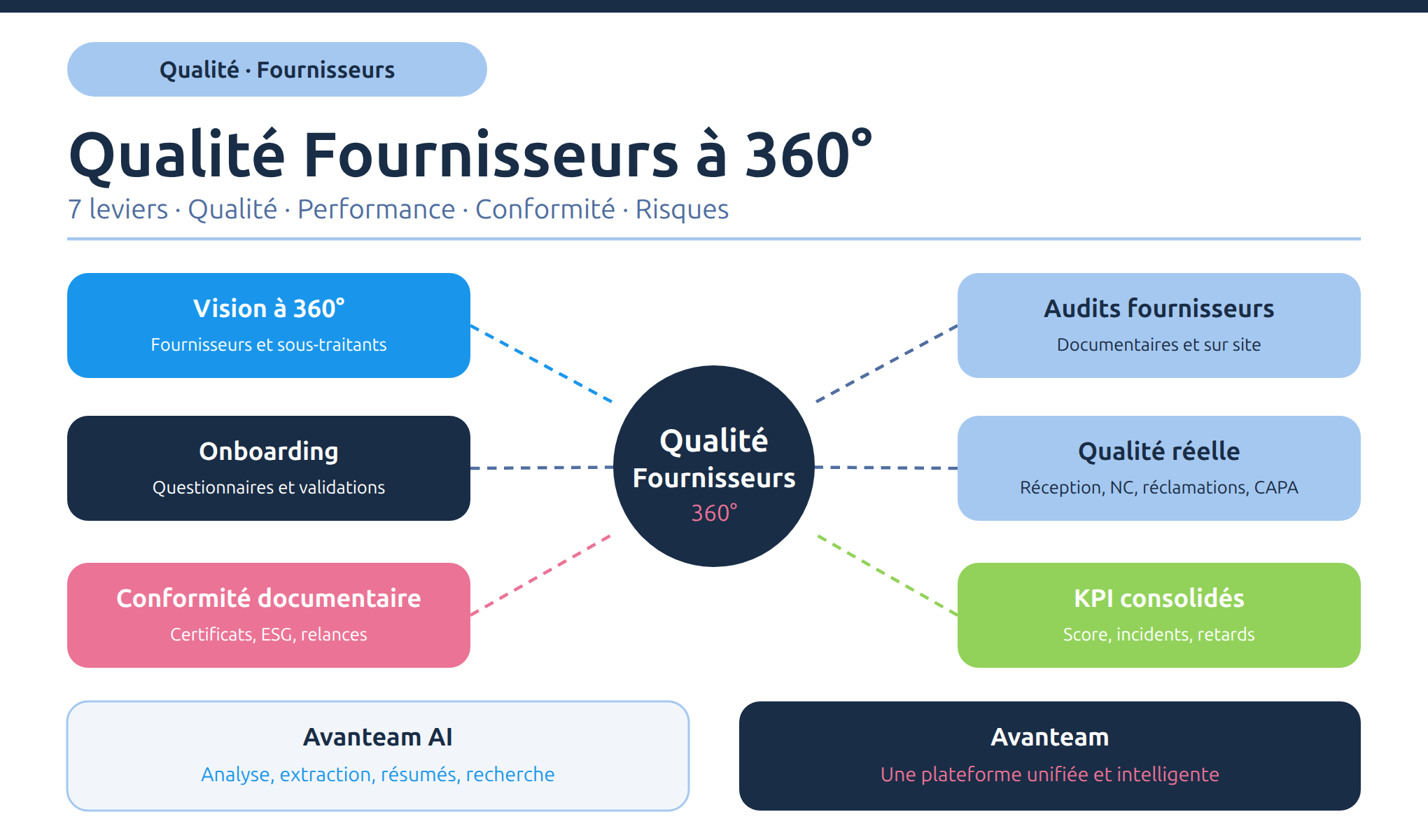
Avanteam’s Supplier Quality module covers these seven areas:
Avanteam's Supplier Quality Module
- 360° View: Consolidate your data repository from your ERP or procurement software and segment suppliers and subcontractors based on their business activity, criticality, location, and risk level
- Onboarding and Qualification: Automate questionnaires, requests for supporting documents, approval workflows, and initial assessments
- Document Compliance: Launch your campaigns to collect and renew ESG certificates, attestations, and commitments, with automatic alerts and reminders
- Supplier audits: Tailor your checklists to each category, schedule document-based or on-site audits, and centralize findings, discrepancies, and action plans
- Actual Quality: Link each supplier to its incoming inspection results, nonconformities, complaints, and CAPA actions
- Consolidated KPIs: supplier score, quality incidents, expired documents, overdue actions
- Avanteam AI: document analysis, extraction of key information, report and audit summaries, instant search of your files
Illustrative example: a manufacturer and its subcontractors
Consider the case of this manufacturer that works with several hundred suppliers, some of whom in turn use subcontractors. Its supplier database was stored in the ERP system, its certificates in a shared folder, and its audit reports in Excel files. By consolidating the supplier database in Avanteam and segmenting its supplier base, the quality team was able to focus its audits on critical suppliers. Documentation campaigns have automated the collection and renewal of certificates as much as possible. Every non-conformity identified upon receipt is now linked to the relevant supplier, and the supplier review is based on a dashboard shared with the Procurement department.
Conclusion: From Administrative Compliance to True Mastery
Supplier quality is no longer limited to a certification file. It involves knowing, at all times, whether each supplier and its subcontractors are meeting your quality, compliance, and ESG requirements, and whether the quality they deliver is up to standard.
Organizations that link qualifications, documentation, audits, and verified quality find it easier to prepare for audits and respond more quickly to deviations. They also transform the supplier relationship: interactions are based on shared facts rather than impressions.
The starting point is simple: a common framework, clear segmentation, and a few metrics tracked over time.