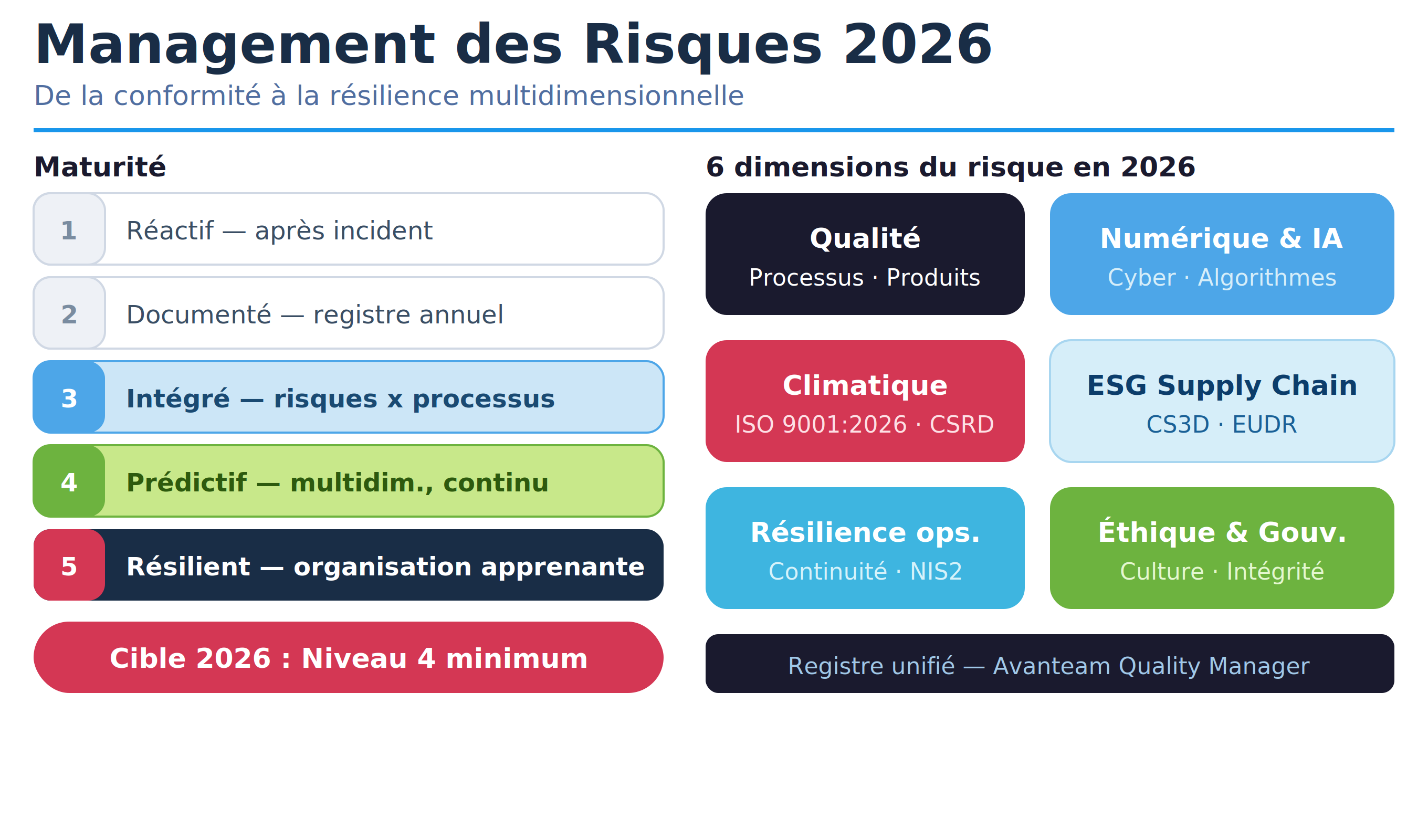
In 2026, risk management can no longer be reduced to an Excel spreadsheet updated once a year to satisfy the ISO auditor. The AI Act requires the mapping of AI risks. NIS2 mandates cyber risk management. The CSRD requires a double materiality analysis. ISO 9001:2026 distinguishes between risks and opportunities. The result? Risk management becomes multidimensional, continuous, and strategic—and the quality manager is its natural leader.
Why the risk management approach of 2015 is no longer sufficient in 2026
The introduction of risk management in ISO 9001:2015 was a major step forward. However, it focused primarily on operational risks related to quality processes and customer satisfaction. By 2026, the scope of risks had expanded dramatically in every dimension.
| Risk dimension | New scope required in 2026 | Related regulatory framework |
|---|---|---|
| Quality risks | Processes, products, suppliers (unchanged) | ISO 9001 |
| Digital Risks & AI | Information systems, algorithms, cybersecurity | AI Act, NIS2 |
| Climate and Environmental Risks | Impact of climate on activities; impact of activities on climate | ISO 9001:2026, CSRD |
| ESG risks in the supply chain | Human Rights, Environment, and Governance Among Suppliers | CS3D, duty of care, EUDR |
| Operational Resilience Risks | Business continuity, critical dependencies, crisis management | NIS2, ISO 22301 |
| Ethical & Governance Risks | Quality Culture, Integrity, Conflicts of Interest | ISO 9001:2026, CSRD |
The good news: a single approach for all these risks
Despite the diversity of these areas, the approach remains the same: identify, assess, address, and monitor. What the quality manager already does for quality risks applies directly to these other areas, albeit with different data sources and assessment criteria.
The challenge is not to master every specialized field (cybersecurity, environmental law, carbon finance), but rather to coordinate the process and ensure the consistency of the overall risk framework. This is precisely the role of an experienced quality manager.
✓ The strategic pivot
By 2026, the quality manager who oversees multidimensional risk management will become a key player in corporate governance. They will discuss risks with the Executive Committee, compliance with legal counsel, cybersecurity with the IT department, and ESG with Human Resources and Procurement. This represents a significant elevation of the role.
The 5 Major Trends in Quality Risk Management in 2026
Risks and opportunities are now distinct
ISO 9001:2026 explicitly separates risks (threats to be mitigated) from opportunities (levers to be seized) into two distinct subsections of Clause 6. Gone are the days of a hybrid table where risks and opportunities were lumped together. This separation requires that opportunities be treated with the same rigor as risks—and that they not be neglected in favor of addressing only the threats.
Climate risk is being incorporated into the QMS
Since the A1 amendment of 2024 and its incorporation into ISO 9001:2026, climate change must be included in the context analysis. Specifically: What climate-related risks (drought, flooding, heat waves, climate-related supply chain disruptions) could affect your processes? And what is your Scope 1, 2, and 3 carbon footprint? These questions must be included in your risk register.
Resilience as an evaluation criterion
The 2026 risk approach goes beyond probability × impact. It incorporates resilience: what is the organization’s ability to absorb the shock if the risk materializes? This dimension requires consideration of business continuity, contingency plans, and recovery times—not just prevention.
Supplier risks extend throughout the supply chain
Qualifying direct suppliers is no longer sufficient. Supply chain regulations (EUDR, CS3D) require risk assessments at levels 2 and 3 of the supply chain. Your risk register must include your suppliers’ strategic suppliers, using a criticality-based approach.
Risk reviews are now conducted on an ongoing basis
An annual risk review is no longer sufficient in such a rapidly changing regulatory and geopolitical environment. Cyber risks evolve on a daily basis. Regulatory requirements change with every legislative session. Risk management must become a continuous process, with automatic triggers for review (new incident, new regulation, change in supplier).
The 5-Level Maturity Model for Risk Management
| Level | Description | What's missing to take it to the next level |
|---|---|---|
| 1 — Reagent | Incident management after the fact. No formalized log. | Establish a basic risk register for each process. |
| 2 — Documented | Existing risk register, updated annually for the audit. | Link risks to action plans and KPIs. |
| 3 — Integrated | Risks incorporated into processes, quarterly review, related corrective and preventive actions. | Expand to include ESG, cyber, and climate risks. |
| 4 — Predictive | Multidimensional risks, detection of weak signals, ongoing review. | Automate monitoring and alerts using a single tool. |
| 5 — Resilient | A learning organization, anticipated risks, proven resilience. | External benchmarking, sharing of industry best practices. |
How Avanteam Quality Manager Structures Your Multidimensional Risk Management
⚖️ Avanteam Quality Manager — Unified, Multidimensional Risk Register
Centralized Risk Registry — all your risks (quality, ESG, cyber, climate, supply chain) in a single repository, with configurable assessment criteria by category.
Separation of risks and opportunities — two distinct sections in accordance with ISO 9001:2026, with separate handling processes and monitoring of the associated action plans.
Visual risk mapping — heat maps and criticality matrices automatically generated from your assessments, exportable for management review.
Automatic links between risks and CAPA — each materialized risk automatically generates a tracked corrective action, without the need for re-entry.
Automatic review triggers — configurable alerts to review risks in the event of an incident, regulatory change, or process modification.
Real-time Risk Dashboard — a consolidated view of critical risks, overdue action plans, and performance metrics by risk category.
Use case: an agri-food cooperative
This agri-food cooperative restructured its risk management using Avanteam Quality Manager to incorporate four new dimensions: climate risks (drought affecting supplies), supplier ESG risks (EUDR), cyber risks (NIS2—relevant sector), and CSRD risks (Scope 3). The unified register identified three systemic risks that spanned multiple dimensions—risks that were not visible in the previous siloed approach. Action plans were consolidated, reducing the number of isolated actions by 40% in favor of more effective cross-functional measures.
Conclusion: Risk Management as a Strategic Tool for Quality Managers
The quality manager who oversees a multidimensional risk management approach is no longer merely a compliance specialist—he or she is an architect of organizational resilience. It is this manager who provides senior leadership with the big-picture perspective they need to navigate an uncertain environment.
Invest in this change. The tools are there. The method is there. What’s sometimes missing is simply the willingness to move beyond the annual Excel spreadsheet.

Coralie Levy
Product Manager · Avanteam