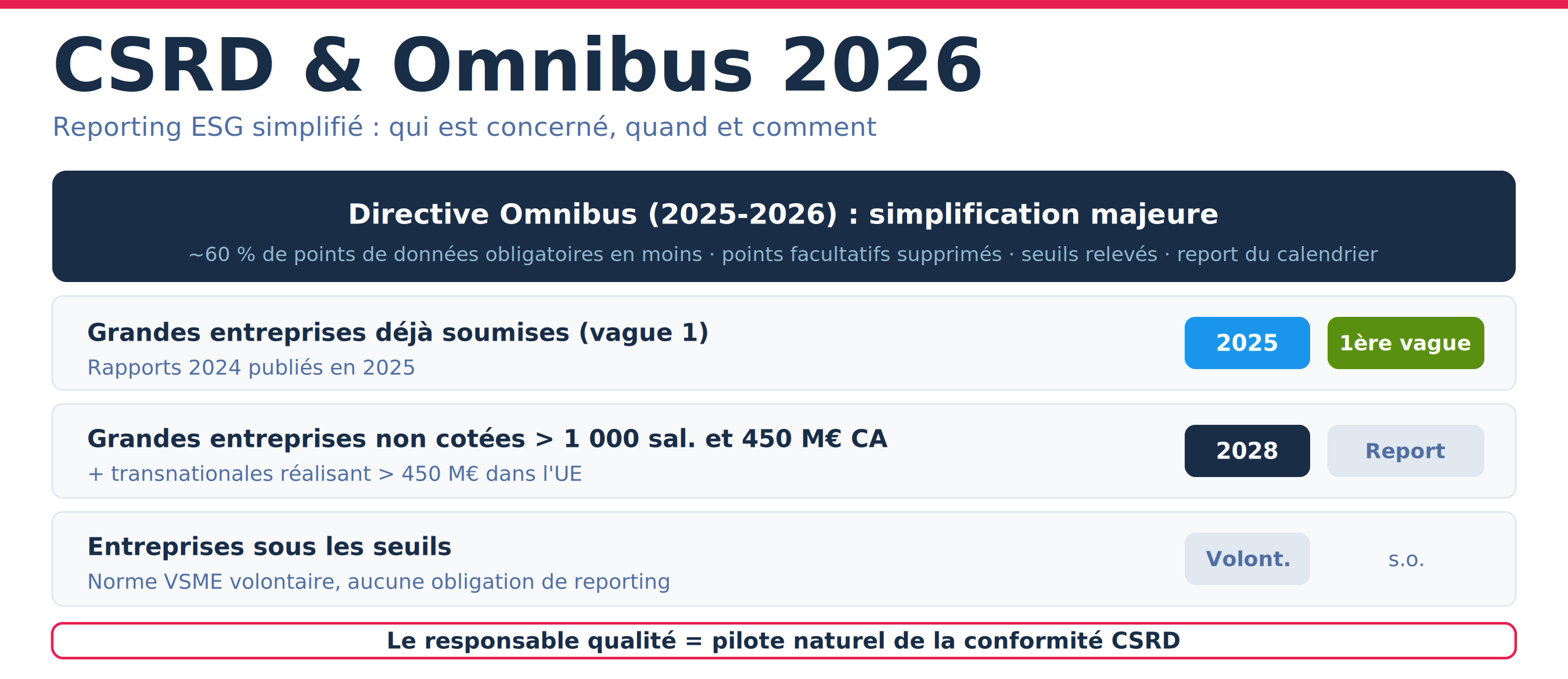
Adopted in late 2025 and published in the Official Journal of the European Union in February 2026, the “Omnibus” Directive simplified the CSRD but did not eliminate it. For thousands of organizations, ESG reporting remains a real obligation, with traceability, documentation, and governance requirements that fall squarely within the scope of quality management. Here’s an overview of what’s changing, what remains mandatory, and how your quality system can become the driving force behind your ESG compliance.
CSRD: A Review of the Context and Issues at Stake
The Corporate Sustainability Reporting Directive (CSRD) is the European directive that requires companies to publish detailed reports on their environmental, social, and governance (ESG) performance. Its goal is to harmonize and make the non-financial information reported by European companies comparable for investors, customers, and citizens.
The CSRD is based on the ESRS (European Sustainability Reporting Standards), which clearly define what data to collect, how to measure it, and how to present it.
Specifically, the ESRS are organized around two cross-cutting standards (ESRS 1, general requirements, and ESRS 2, general information on governance, strategy, and management) and ten thematic standards: five environmental standards—climate (E1), pollution (E2), water and marine resources (E3), biodiversity (E4), and the circular economy (E5)—four social standards—company employees (S1), workers in the value chain (S2), affected communities (S3), and consumers and end users (S4)—and one governance standard: business conduct (G1). A company reports only on the topics it has deemed relevant.
Note: An organization that is already ISO 14001-certified has an environmental management system that provides a useful foundation for the environmental standards (E1 through E5). Similarly, an ISO 9001 quality management system already provides the documentation control, evidence management, and continuous improvement framework expected by the CSRD. While these standards do not cover the entire scope of ESG, they serve as a foundation to build upon rather than starting from scratch.
The Omnibus Package: What Changed in December 2025?
On December 16, 2025, the European Parliament adopted the “Omnibus” Directive, which was approved by the Council of the European Union on February 24, 2026, published in the Official Journal on February 26, 2026, and entered into force in March 2026. Member States must transpose it into their national law by March 2027. It introduces a major simplification of the original CSRD framework.
Reduction in the volume of data to be reported — the ESRS standards were revised by a delegated act adopted on July 3, 2026, which eliminates approximately 60 percent of the mandatory data points and refocuses reporting on information that is truly material. This simplified version applies to fiscal years beginning in 2027 or later.
Raising the thresholds and postponing the timeline —only companies with more than 1,000 employees and €450 million in net revenue remain subject to the requirement. The large companies affected that are not yet subject to the requirement will publish their first report in 2028, covering the 2027 fiscal year. Approximately 80% of the organizations initially targeted are no longer subject to the mandatory requirement.
VSME Voluntary Standard — Companies that fall below the thresholds are no longer required to report; they can rely on the much less burdensome VSME voluntary standard, particularly when their clients or investors request ESG data.
"Stop-the-Clock" extension as of April 3, 2025 — a two-year extension had already been granted for companies in the second and third waves.
⚠ What Omnibus does NOT change
Large companies that fall above the new thresholds (1,000 employees and €450 million in revenue) remain fully subject to the regulations, and the first wave of companies has already published their reports. The CSRD is not dead—it has been simplified and refocused. Traceability and documentation requirements remain in place, and supply chain issues are still within the scope of the regulations.
The CSRD Timeline After the Omnibus Act: Who Is Affected, and When?
| Business Category | First CSRD Report | For the fiscal year |
|---|---|---|
| Large companies already in Wave 1 (still above the thresholds) | 2025 (already published) | 2024 |
| Large unlisted companies > 1,000 employees and €450 million in revenue | 2028 | 2027 |
| Non-European companies > €450 million in revenue in the EU | 2028 | 2027 |
| SMEs listed on regulated markets | Excluded from the required fields (voluntary VSME) | N/A |
| Companies Below the Thresholds | Not mandatory; VSME is a voluntary standard | Volunteer |
Why the Quality Manager Is Central to CSRD Compliance
CSRD reporting is not a communication exercise; it is an exercise in performance management and evidence-based decision-making. It requires exactly what quality managers do on a daily basis:
Data collection and reliability assurance —carbon emissions, energy consumption, accident rates, social indicators, and more. This data must be traceable, verified, and auditable.
Documentation and Traceability — Each ESRS indicator must be supported by robust documentary evidence. External auditors will verify consistency between statements and records.
ESG Risk Management — Identifying and prioritizing the most significant ESG issues is part of a risk assessment process, a skill at the heart of the quality function.
Supplier Management — Scope 3 carbon emissions and due diligence obligations require an assessment of ESG practices throughout the entire supply chain.
Continuous improvement — the CSRD objectives (emissions reduction, improvement of working conditions) are directly aligned with the PDCA cycle.
✓ A Natural Convergence
A mature management system—covering quality (ISO 9001) and, where applicable, the environment (ISO 14001)—already provides the essentials required by the CSRD: context and risk analysis, document control, evidence management, monitoring of indicators, and continuous improvement. Organizations that have these systems in place do not have to start from scratch: it is a matter of expanding and integrating existing processes with ESG considerations.
The 5 Practical Areas of Focus for CSRD Compliance for Quality Teams
Mapping of Issues and Indicators to Be Reported
Identify the sustainability issues relevant to your organization, then prioritize the ESRS indicators to be collected based on their importance and the associated risks. This selection process is similar to the analysis of context, stakeholders, and risks and opportunities already practiced under ISO 9001.
Implementation of the ESG Data Collection System
Define the data sources for each metric (HR, production, purchasing, maintenance, etc.), the individuals responsible for data collection, the frequencies, and the formats. Centralizing this information in a single tool is essential to ensure consistency and auditability.
Documentation and Traceability of Evidence
Each piece of reported data must be supported by documentary evidence: energy bills, social security filings, incident reports, and supplier evaluations. Quality document management is the foundation of CSRD compliance.
ESG Assessment of Suppliers
Scope 3 and due diligence obligations require you to extend your supplier quality management approach to include ESG considerations. ESG qualification questionnaires, on-site audits, and monitoring of improvement plans: the process is the same as your current quality qualification process. However, the Omnibus Directive sets limits on the information you can require from your smallest suppliers, so as not to place a disproportionate burden on them.
Internal Review and Validation Prior to an External Audit
Implement an internal review of ESG data prior to publication, with approval by management. CSRD auditors (statutory auditors) follow the same principles as ISO auditors: consistency, traceability, and objective evidence.
Succeeding with the CSRD: Getting the CSR and Quality Teams to Work Together
CSRD is not the responsibility of any single function. In most organizations, responsibility for sustainability reporting falls to a team or a CSR lead, often reporting to senior management, finance, or risk management. This team has a firm grasp of the regulatory framework, investor expectations, and the identification of issues to be reported. However, it does not always have the methods and tools to collect, track, and ensure the reliability of the expected volume of data.
This is precisely where the quality function adds significant value. While the CSR team defines what to report, the quality function knows how to document and verify it: data collection procedures, responsibilities, deadlines, evidence management, reviews, and internal audits.
In practical terms, it is helpful to establish early on who is responsible for what (a matrix of responsibilities organized by ESRS indicator group), to share a common document repository, and to integrate the review of ESG data into the existing management review cycle.
How the Avanteam Platform Can Help You Meet CSRD Compliance Requirements
🌱 The Avanteam Platform and CSRD/ESG Challenges
Centralized collection of ESG metrics —configurable data entry forms for your metrics (environmental, social, governance), with data validation, approval, and traceability.
Evidence Management — Link supporting documents (invoices, reports, certificates) to each indicator using Quality Document Manager's EDM system: evidence ready for the audit.
ESG Supplier Assessment — expansion of the existing supplier qualification process to include sustainability criteria, with ratings and improvement plans.
ESG Dashboards — Tracking key metrics and variances from set targets.
Action Plans and Continuous Improvement — initiating, assigning, and tracking corrective actions via Quality Improvement Manager, following the PDCA cycle.
Conclusion: CSRD—An Opportunity to Gain Recognition for the Strategic Value of Quality
The CSRD, even in its simplified form under the Omnibus Act, requires a level of documentation and traceability that the quality function is particularly well-equipped to manage, in close collaboration with the CSR team. This is a rare opportunity to position the quality department as a co-leader of the ESG transformation—and not merely as a contributor.
Don’t let the CSRD be driven solely by finance or HR. Quality has the methods, tools, and legitimacy to be a driving force behind it, alongside the CSR team.