In just two years, artificial intelligence has become firmly established in businesses. Yet for many quality, regulatory, legal, and financial teams, it’s still nothing more than a chat window open alongside their tools. The next step is agent-based AI: AI that no longer merely responds, but actively intervenes in your processes at the right moment, under your control. In this article, we’ll explore the key takeaways from the most recent analyses, twelve concrete use cases, the indispensable role of humans in the loop, and an action plan to get started.
Why AI Must Now Be Integrated Into Processes
Adoption is growing rapidly. In France, 18% of companies with 10 or more employees were using at least one AI technology in 2025, compared with 10% in 2024 and 6% in 2023, according to INSEE. The organization of administrative processes is the area showing the most growth: it will affect 38% of the workforce in 2025, compared with 17% a year earlier.
Individual gains are real but fragile. According to Workday, nearly 9 out of 10 French employees surveyed—who use AI in companies with more than $100 million in revenue—report saving at least one hour per week. Globally, however, nearly 40% of that time saved is lost correcting low-quality results.
On the corporate side, McKinsey observed in 2026 that nearly 9 out of 10 organizations use AI regularly, but that only 37% of respondents attribute at least a portion of their operating income (EBIT) to AI. Agents are a game-changer: at KPMG, the share of large U.S. companies developing or deploying multi-agent systems rose from 9% to 18% in a single quarter. But governance is lagging behind. According to Deloitte, only 21% of the executives surveyed have a mature governance model for agent-based AI.
AI therefore saves time on individual tasks, without yet transforming processes. That is precisely the difference between a chatbot and an integrated agent-based AI system.
📊 Key Figures
18% of French companies with 10 or more employees will be using AI by 2025, three times as many as in 2023 (INSEE).
40% of companies with revenue exceeding $1 billion are deploying AI agents at scale in at least one function, compared with 27% a year earlier (McKinsey, 2026).
33% of enterprise applications will incorporate agent-based AI by 2028, compared with less than 1% in 2024 (Gartner).
More than 40% of agent-based AI projects will be abandoned by the end of 2027 due to a lack of cost control, clear business value, or risk management (Gartner).
Only 21% of the executives surveyed have a mature governance framework for their AI agents (Deloitte, 2026).
The finding: The chatbot stops just before the process begins
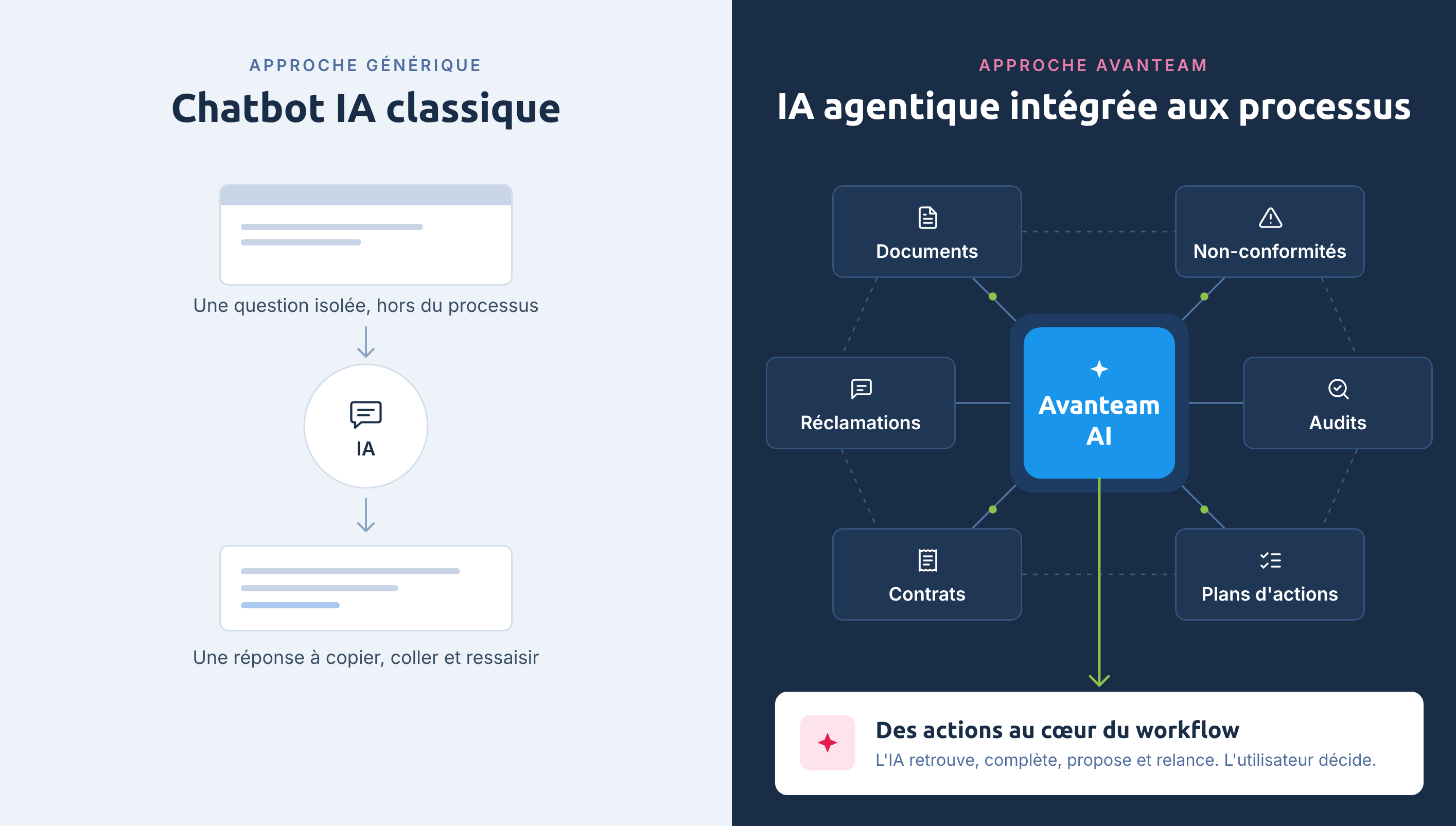
A general-purpose chatbot answers a question or summarizes a document provided to it. This is useful for saving a few minutes. But it works with isolated content. It doesn’t know what stage of the workflow the user is at, what non-compliance issues are similar to the one being handled, which contract is involved, or which documents the user is authorized to view. You copy the response, verify it, and then re-enter it into the business application. The time saved is lost in this back-and-forth.
| Criterion | General-purpose chatbot | Integrated Agent-Based AI |
|---|---|---|
| Background | The text pasted into the conversation | The file, its workflow stage, and its history |
| Data | One document at a time | Documents, fact sheets, attachments, and similar cases on the platform |
| Access Rights | Not taken into account | Verified before each search |
| Result | Text to copy | Fields filled in, actions proposed, workflow triggered |
| Reliability | Difficult to verify | Cited sources; reliability assessed based on your documents |
| Traceability | Outside the quality system | Correspondence and decisions documented in the file |
Key Takeaways from Recent Analyses on Agent-Based AI
Consulting firms, regulatory bodies, and publishers agree on a few key takeaways that are particularly useful for quality and compliance functions.
The gains are focused on documentation and investigation
In the life sciences, McKinsey estimates—based on pilot projects and initial assessments—that documentation agents can deliver a 75 to 80 percent productivity gain on the initial drafting of documents, such as deviation and CAPA reports, procedures, or validation protocols. More broadly, the firm estimates a 25 to 35% reduction in the time required for key tasks in operations. These are estimates, but they clearly point to where value can be found: the reading, research, and writing tasks that precede a decision.
The regulators themselves are hiring the agents
In December 2025, the FDA made agent-based AI capabilities available to all its employees on a voluntary basis, particularly for pre-market reviews, post-market surveillance, inspections, and compliance. The agency notes that these systems are based on built-in rules and human oversight. Quality teams preparing for inspections are facing counterparts who are increasingly well-equipped.
In regulated environments, humans remain part of the process
The draft Annex 22 of the European GMP guidelines, which focuses on artificial intelligence and was submitted for consultation in 2025, excludes generative AI from applications critical to patient safety, product quality, or data integrity. For non-critical uses, qualified personnel remain responsible for verifying the results. The message is clear: AI assists, but the professional makes the decision and retains responsibility.
Avanteam AI: A Multi-Agent Orchestrator at the Heart of the Platform
Avanteam AI is natively integrated into the Avanteam platform, which combines EDM, BPM, and AI. Its core component is a multi-agent orchestrator. The user expresses their need to a single point of contact, AskMe, and the orchestrator selects and coordinates the appropriate tools: finding a document, retrieving an attachment, searching through files, launching a workflow, following up with a stakeholder, filling out a form, summarizing a file, or any custom-built capability.
When it comes to document capture, AIClass employs seven specialized processes: text recognition, classification, entity extraction, company verification via SIRET number, completion of required fields, business-specific checks, and correction. Documents are received via email, OneDrive, or a network folder; they are processed in batches, after which a record is created and the workflow is triggered.
12 Real-World Use Cases, by Industry
1. Quality: Summarize an event in a few sentences
An operator describes an incident observed during production in their own words. The AI analyzes the description, suggests the category, severity, product, and batch involved, and pre-fills the form. The operator reviews and approves it. Data entry is faster, more complete, and more consistent across sites, which in turn facilitates subsequent analyses.
2. Quality: A Pre-Analyzed Customer Complaint
A customer reports an issue with a batch of moisturizer: separation of the texture, an unusual odor, and suspected microbiological contamination. The agent reviews the report and its attachments, checks for similar complaints that have already been handled, and then suggests several options for completing the report’s fields and tables. The quality control specialist selects, adjusts, and validates the information.
3. Quality: Nonconformities and Corrective and Preventive Actions (CAPA) Based on Experience
When a non-compliance issue arises, AskMe identifies similar cases—including those on other sites—and shows how they were analyzed and resolved. The team builds on causes that have already been identified and actions proven to be effective, rather than starting from scratch. The AI can also draft an initial investigation report, which is then reviewed and supplemented by the project lead.
4. Fieldwork: The correct, well-sourced answer at the workstation
An operator asks, “How do I calibrate this machine?” The answer is based on the current operating procedure, with a link that opens the document directly at the cited section. Each answer remains verifiable and is based solely on documents that the user is authorized to view.
5. Documentation: Review procedures after a change
A requirement changes, a new version of a standard is published, or a process changes. AI helps identify the relevant procedures, suggests which sections need to be modified, and prepares a revised version. The writer edits the text, and then the usual review and approval process takes place.
6. Audits: Preparing, Conducting, and Analyzing an Audit
Before the audit, the AI summarizes the history of the audited scope (recent findings, open actions, recurring nonconformities) and generates a questionnaire tailored to the standards. After the audit, it helps organize the findings, draft the report, and propose corresponding actions, which the auditor validates one by one.
✓ Advice
Before each audit, ask the AI for a list of open issues and recurring discrepancies within the audited scope. A few minutes of preparation can help you avoid unanswered questions on the day of the audit.
7. Regulatory: Proof of Compliance and Gap Analysis
AI captures evidence of compliance, tracks deadlines, and helps analyze discrepancies between your documented practices and the requirements of a standard or regulation. Before an inspection or certification audit, the team can quickly obtain a list of the requirements that have been met, the associated evidence, and any items that need to be completed.
8. Supplier Quality: Certificates and ESG Under Review
ESG certificates, attestations, and questionnaires submitted by suppliers are processed automatically. The AI populates the supplier’s record with validity dates and issues alerts before they expire. All it takes is a single question in natural language: “Which critical suppliers have certifications that expire within three months?”
9. Risks: Analyze Data and Identify Deviations
AI analyzes audit reports, FMEA analyses, laboratory results, and quality indicators to identify trends and early warning signs. It helps prioritize risks and prepare for a management review, citing the data on which its findings are based.
10. Contracts: A Contract That Is Read, Summarized, and Tracked
When a contract is uploaded to Contract Manager, key data is entered automatically: parties, amounts, date of signature, term, expiration date, and notice period. The AI generates summaries tailored to each audience, flags critical clauses such as penalties or tacit renewal, and schedules tasks to track compliance.
11. Contracts and Quality: Cross-Cutting Issues
Because contracts, suppliers, and claims are all managed on the same platform, all it takes is one question: “Which contracts are set to expire this quarter with suppliers who have open claims?” The buyer approaches renegotiations armed with facts. When establishing a business relationship, the AI also verifies supporting documents (Kbis, bank account information, certificates) and the company’s existence using its SIRET number.
12. Finance: From Incoming Invoice to Approval Workflow
A supplier invoice arrives in an email inbox. AIClass captures it, reads it, identifies its type, extracts the invoice number, date, and supplier, verifies the supplier’s SIRET number, breaks down the VAT rates and item lines, creates the record, and triggers the approval process.
| Field | Tasks | What AI Does | What Humans Decide |
|---|---|---|---|
| Quality | Incidents, Complaints, Nonconformities, and Corrective and Preventive Actions | Fill in the blanks, find similar examples, and write a first draft | Classification, causes, actions |
| Land and Documentation | Operational issues, review of procedures | Respond by citing your sources and suggest which passages to change | Approval of Documents |
| Risks | Quality Data Analysis | Highlights trends and weak signals | Priorities and Trade-offs |
| Audits | Preparation, Report, Actions | Summarizes the history, generates the questionnaire, and organizes the findings | Key Findings, Action Plan |
| Regulatory | Evidence, Deadlines, Variance Analysis | Collect evidence, compare it to requirements, and issue an alert | Interpretation, Priorities |
| Suppliers | Certificates, ESG, Monitoring | Reads documents, enters dates, sends alerts | Supplier Status |
| Contracts | Seizure, Clauses, Obligations | Extract, summarize, and highlight the critical clauses | Legal Review, Negotiation |
| Finance | Supplier Invoices | Capture, extract, verify, route | Confirmation and Payment |
Human-in-the-Loop: AI Assists, the Professional Decides
AI used in quality or regulatory processes places the responsibility on the company. The question, therefore, is not whether humans remain in the loop, but where and how. There are three reasons why this is essential.
The quality of the results —the time spent on corrections, as measured by Workday, shows that AI that isn’t properly supervised merely shifts the workload rather than reducing it. Targeted validation at the right time is less costly than making corrections later on.
Accountability —whether in an audit or an inspection—lies with the company, which is responsible for its decisions. A proposal from the AI is not considered a decision until it has been approved by an authorized person.
The regulatory framework —Section 14 of the AI Act provides for human oversight of high-risk systems, with the related requirements being phased in gradually. For low-risk applications, it mandates transparency. In the pharmaceutical industry, the draft Annex 22 of the GMP guidelines follows the same approach.
Avanteam AI applies this principle at every stage:
The AI makes suggestions; the user approves them—whether it’s pre-filled fields, options, summaries, or suggested actions: nothing is applied without the user’s consent, and the user can approve, adjust, or reject them. For document capture, the record created by AIClass enters the designated approval workflow, where a reviewer checks the data before any decision is made.
Agents with defined scopes —each agent can be limited to a specific form and a specific step in the workflow. They step in where they're needed, and nowhere else.
Verifiable answers —each answer cites its sources, with a link to the document and the relevant passage.
Measured reliability —the benchmark assigns a confidence level to each extracted field and indicates the percentage of documents that are usable without proofreading. You know where to focus your human verification efforts.
Rights are respected —access rights are verified before each search, and the model sees only the necessary excerpts.
Transparency and traceability —users are informed that they are interacting with an AI, a warning reminds them that responses may be incorrect, and a history of interactions is retained. According to Avanteam’s analysis, AskMe and AIClass are classified as “limited-risk systems” under Article 50 of the AI Act, which has been in effect since August 2, 2026.
✓ The Right Response
For each agent, clearly document in writing what they can offer, what requires approval, and who grants it. This simple table serves as both a set of specifications, a training resource, and audit evidence.
Agents configured by your business units, based on the model of your choice
Avanteam AI agents can be configured by business administrators without any development work. For each agent, you define its prompt, scope, and mode: either a simple call to the model to generate content, or a full-fledged agent capable of invoking tools, iterating, and producing a structured result.
The architecture is open and multi-LLM: models from OpenAI, Anthropic, Google, Mistral AI, or Meta can be combined depending on the use case and budget, and new capabilities such as vision or voice can be added without rewriting applications. Hosting options align with your policy: Avanteam Online, on-premises, or open-source models hosted in France by OVHcloud. Data is not used to train the models, and the system is designed to never execute the instructions contained in the analyzed documents.
Finally, reliability is measured before deployment. On a test batch of 25 invoices, the benchmark achieved 96.9% accuracy, with all 25 documents ready for use. These results depend on your specific documents, which is why it’s important to test them on your own dataset.
A 5-Step Action Plan for Deploying Agent-Based AI
Choose two or three high-volume use cases
Claims, invoices, supplier certificates, or audit preparation: Focus on repetitive, measurable, and tedious tasks.
Measure on your documents
Run a benchmark on a real-world sample and set the expected reliability threshold before going live.
Define the scope of each agent
Forms, steps, authorized tools, access rights: a clearly defined agent is more reliable and easier to audit.
Choose models and accommodations
Balance performance, cost, and data sovereignty on a case-by-case basis.
Keep people in the loop and track your metrics
Processing time, acceptance rate, corrections, closing deadlines: Train agents based on the facts.
⚠ Start small, measure your results, then scale up
There’s no need to automate everything at once. A single successful use case—one that’s been costed and validated by the teams—is more convincing than ten unfinished pilot projects.
How Avanteam AI Supports You
🤖 Avanteam AI at a Glance
Multi-agent orchestrator — AskMe understands the request, selects the tools, and takes action within your workflows.
Intelligent Capture — AIClass classifies, extracts, verifies, and creates the record, with a reliability benchmark.
Use Cases — Quality, Field Operations, Documentation, Audits, Regulatory Compliance, Suppliers, Risks, Contracts, Finance.
Human in the Loop — AI makes a suggestion, the user approves it, and everything is tracked.
Open and independent — multi-LLM, Avanteam Online, on-premises, or hosted in France.
Configurable — agents configured by your business administrators, without any development work.
Illustrative example: A cosmetics manufacturer before its certification audit
Let’s consider the case of a cosmetics manufacturer with multiple sites, just a few weeks away from its certification audit. Its complaints, nonconformities, procedures, and supplier records are already in Avanteam. The quality manager asks AskMe for a summary of the findings from the previous audit and any open actions, followed by a list of critical suppliers whose certificates are set to expire before the audit. The complaints from the quarter are pre-analyzed and cross-referenced with similar cases from another site. An internal audit questionnaire is generated, reviewed, and adjusted. At each step, the AI made suggestions and the team made the final decisions. On the day of the audit, every response is backed by a document accessible with a single click.
Conclusion: From Experimentation to Value
The chatbot was just the first step. Value is now created when AI operates within the context of the business, as part of business processes, under clear governance, and with humans in the loop. The organizations that will succeed are not the ones with the most agents, but those that have chosen the right use cases, measured reliability, and defined who makes the decisions.
That’s the choice Avanteam has made: an agent-based AI integrated into the platform, configurable by business units, compatible with all major models, and testable before deployment. Avanteam AI is available for versions 23 and 26 of the platform.
About Avanteam — With over 20 years of expertise and more than 500 clients, Avanteam helps demanding industries ensure regulatory compliance and improve operational performance through a unified, intelligent platform for document and business process management.
Sources
- INSEE, INSEE Première No. 2120, “ICT in Businesses in 2025,” July 2026
- McKinsey, “The State of AI,” 2026 survey (1,719 respondents, 97 countries)
- McKinsey, “Reimagining Life Science Enterprises with Agentic AI,” September 2025
- Gartner, “Over 40% of Agentic AI Projects Will Be Canceled by the End of 2027,” June 25, 2025
- Deloitte Insights, “AI Agents Are Scaling Faster Than Their Safeguards,” April 2026 (3,235 respondents, 24 countries)
- KPMG, AI Quarterly Pulse, 2nd Quarter 2026, June 24, 2026
- Workday, “Companies Are Failing to Fully Leverage the Benefits of AI,” January 14, 2026
- PharmExec, “FDA Announces Agency-Wide Deployment of Agentic AI Tools,” December 2025
- Learnsignal, “EU GMP Annex 22: The First Draft Rules for AI in Pharmaceutical Manufacturing”
- Regulation (EU) 2024/1689 on AI, Articles 14 and 50, EUR-Lex