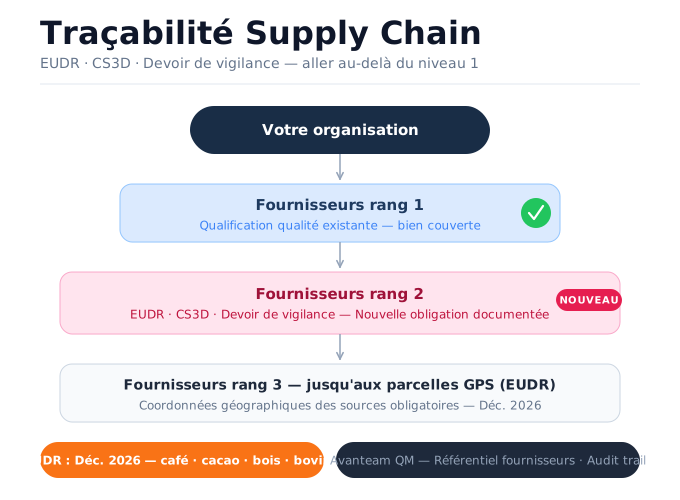
The EUDR on deforestation, the CS3D on due diligence, Scope 3 of the CSRD, France’s 2017 law on due diligence… Regulatory pressure on supply chains has never been greater. By 2026, going beyond Tier 1 of your suppliers will no longer be optional. It will be mandatory. Here’s what that means in practice for your quality and regulatory function.
The regulatory landscape: a patchwork of laws that converge
Supply chain traceability is now governed by a set of regulatory texts that reinforce one another. For quality and regulatory managers, it is essential to understand this ecosystem to avoid treating each regulation in isolation.
| Regulations | Scope | Key milestone: 2026 |
|---|---|---|
| Duty of Care Act (France, 2017) | Companies > 5,000 employees in France or > 10,000 employees worldwide — human rights, environment, safety | In effect — enhanced controls |
| CS3D (EU Directive) | Major European companies — human rights and the environment throughout the supply chain | Transposition into national law: July 2026 |
| EUDR (Deforestation) | Coffee, cocoa, timber, cattle, soybeans, palm oil, rubber, and rubber products | Dec. 2026 (large/medium-sized businesses) |
| CSRD Scope 3 | All companies subject to the CSRD — indirect emissions from the supply chain | According to the company's CSRD timeline |
| ISO 9001:2026 | All certified organizations — enhanced supply chain resilience | Transition through 2029 |
The EUDR in detail: the most urgent documentation project
The European Deforestation Regulation (EUDR) is the most practical and urgent piece of legislation for companies in the affected sectors. Its core principle is that, before placing listed products (and their derivatives) on the European market, operators must demonstrate that these products do not contribute to deforestation.
What the EUDR actually requires
Traceability down to the individual plots of land —GPS coordinates of the fields where the raw materials are sourced, offering an unprecedented level of detail.
Statement of due diligence — for each batch placed on the market, a complete dossier must be submitted to the EUDR platform.
Risk assessment and mitigation — formalized analysis of deforestation risk for each supply source, updated at least annually.
Supplier audit — a documented verification that suppliers comply with EUDR requirements, including the right to conduct contractual audits.
⚠ EUDR Sanctions
Non-compliance may result in fines of up to 4% of annual turnover in the EU, as well as the seizure of goods and bans on placing products on the market. Customs inspections will begin on December 30, 2026.
The Duty of Care: From Compliance to ESG Risk Management
The scope of the duty of care extends beyond the EUDR: it requires large companies to identify, prevent, and mitigate human rights and environmental risks throughout their entire supply chain, including among subcontractors of subcontractors.
For quality managers, this amounts to a natural extension of existing supplier qualification processes—but with much broader coverage and far more rigorous documentation requirements.
The 5 pillars of a robust vigilance program
Supply Chain Risk Mapping
Identify all suppliers and subcontractors with whom you have a direct or indirect business relationship, and assess the human and environmental risks associated with each link in the chain.
Regular evaluation procedures
Implement ESG questionnaires, document reviews, and on-site visits to assess your suppliers’ practices beyond just quality criteria.
Prevention and mitigation measures
Develop improvement plans for suppliers identified as high-risk. Include due diligence clauses in all new contracts.
Alert and Appeal Mechanism
Establish a mechanism that allows stakeholders (workers, local communities) to report violations. This mechanism must be accessible and traceable.
Monitoring and Continuous Improvement
Assess the effectiveness of the vigilance plan annually. Publish a summary in the sustainability report.
The 4 Most Common Mistakes in Supply Chain Traceability Management
Mistake 1: Covering only Tier 1 suppliers
Most risks (forced labor, deforestation, human rights violations) occur at levels 2 and 3 of the supply chain. Regulations now require companies to look beyond their direct suppliers.
Mistake 2: Treating traceability as a one-off project
The EUDR requires annual updates to risk assessments. Due diligence is an ongoing process. Supply-chain traceability must be integrated into daily operations, not treated as a one-time audit.
Mistake 3: Managing data in spreadsheets
Coordinating hundreds of suppliers, collecting documents (certificates, GPS coordinates, attestations), and tracking versions and approvals: it’s impossible to manage this manually in a reliable and auditable way.
Mistake 4: Ignoring the risks of joint liability
In France, if an irregularity is found on the part of a contractor, the client may be held jointly liable. It is no longer sufficient to simply include contractual clauses without verifying that they are being enforced.
How Avanteam Structures Your Supply Chain Traceability
🌍 Avanteam Quality Manager — Supply Chain Traceability & Compliance
Centralized Supplier Database — comprehensive profile for each supplier, including compliance status, valid/expired documents, ESG risk level, and assessment history.
ESG/EUDR Qualification Questionnaires — customizable templates for collecting statements from your suppliers regarding deforestation, human rights, and environmental practices.
Document management for evidence — collection, validation, and archiving of certificates, attestations, GPS coordinates, and EUDR declarations, with alerts for expiration dates.
Supplier audit workflows — planning, conducting, and tracking supplier audits using configurable evaluation grids and automatically generated action plans.
Supply Chain Risk Mapping — Visualize risk levels by supplier, country, and product category to prioritize your actions.
Tracking of improvement plans — corrective actions assigned to non-compliant suppliers with deadlines, automatic reminders, and closure tracking.
Use case: a coffee importer (EUDR sector)
A European coffee importer works with 45 cooperatives in 8 producing countries. Under the EUDR, the importer must collect GPS coordinates for each production plot and submit a due diligence declaration for each batch. Thanks to Avanteam Quality Manager, the process is fully digitized: GPS collection forms are sent to the cooperatives, data consistency is automatically validated, evidence is archived, and EUDR declarations are generated semi-automatically. The administrative burden has been reduced by 70% compared to the initial manual process.
Use case: An automotive parts supplier (duty of care)
An automotive supplier subject to due diligence requirements has expanded its Avanteam Quality Manager supplier module to include ESG criteria. The 230 Tier 1 suppliers were scored on 45 CSR criteria. The 12 suppliers identified as high-risk received an improvement plan with deadlines and monthly follow-ups. The annual due diligence plan is generated automatically from centralized data.
Conclusion: Supply Chain Traceability, the New Frontier of Quality
Supply chain traceability is no longer a concern limited to buyers or legal professionals. It is a quality issue in its own right, one that employs the same methods (risk mapping, qualification, auditing, continuous improvement) and tools as product quality.
Quality managers who have successfully integrated supply chain considerations into their quality management systems will be the ones who bring the most value to their organizations in the years to come.
Want to learn more? Let’s talk about your situation.
Request an Avanteam Flash Diagnostic — free of charge and with no obligation.

Author
Hugues Van Loo
Project Manager · Avanteam