Audits conducted by Occupational Health and Safety Services (SPST) no longer merely verify the existence of a PPE management procedure or a prevention plan. They examine the safety culture: do employees voluntarily report near-misses? Does management visibly respond to early warning signs? Is workplace well-being measured and managed? This represents a profound paradigm shift and a major opportunity for SPST managers who know how to seize it.
The Shift: From Procedural Compliance to a Safety Culture
For decades, workplace safety was treated as a compliance issue: posting safety guidelines, training employees, documenting accidents, and producing the annual DUERP report. The real challenge—ensuring that safe behaviors are adopted spontaneously by everyone—was often overlooked.
By 2026, this shift will be well established. Major companies in regulated sectors (nuclear, chemical, pharmaceutical, and heavy industry) have long understood that a safety culture is the most important factor in prevention. This approach is now becoming standard across all sectors, driven by updated standards, stricter inspections, and stakeholder expectations.
📊 A thought-provoking statistic
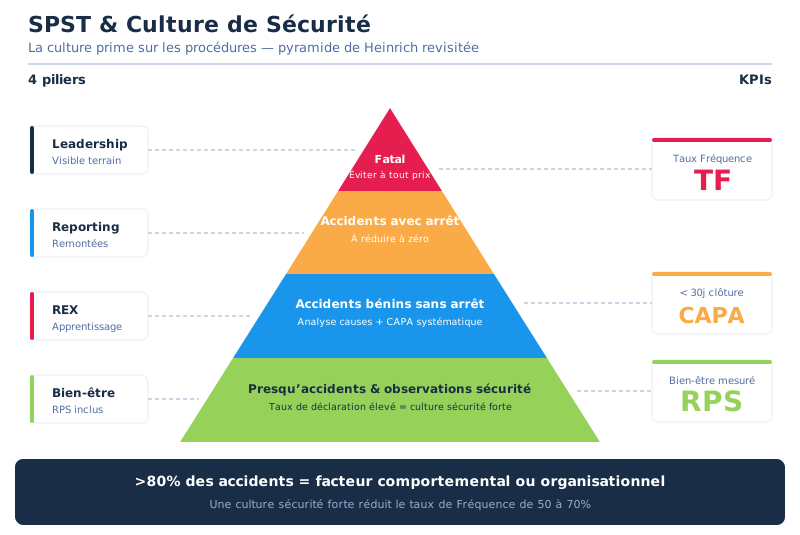
According to available studies, more than 80% of workplace accidents involve a behavioral or organizational factor. Procedures alone do not prevent accidents; it is everyday behaviors that do. A strong safety culture can reduce the accident frequency rate by 50 to 70%.
- >80% of accidents involve a behavioral factor
- A 50–70% reduction in turnover with a strong safety culture
- 30-day target deadline for closing safety CAPAs
The 4 pillars of a strong safety culture
A strong safety culture cannot be imposed; it is built on four complementary pillars, each of which can be measured and managed with the right tools.
| Pillar | Description | Sign of maturity |
|---|---|---|
| 👁️ Visible leadership | In high-reliability organizations (HROs), executives and managers regularly conduct safety walk-throughs, ask questions about working conditions, and take visible action in response to feedback. | This "visible" leadership sends a strong message: safety is a real priority, not just a poster in the hallway. |
| 📢 Positive news | An organization with a strong safety culture has a high rate of near-miss reporting, not because there are more incidents, but because employees trust the system. | This rate is a far more telling indicator of cultural maturity than the accident rate. |
| 🔍 REX Learning | Every accident or near-miss is a learning opportunity. Mature organizations systematically analyze root causes (cause trees, the 5 Whys) and share the lessons learned at all levels. | REXs are managerial rituals, not administrative tasks. |
| 🧠 Holistic Well-being | Mental health, stress, burnout, and psychosocial risks (PSRs) are now recognized as occupational risk factors on par with physical risks. | An organization that does not measure its employees' well-being is not truly managing their safety. |
SPST Regulatory Changes: What’s New in 2026
ISO 45001: Toward a Culture-Focused Revision
ISO 45001:2018 is the leading international standard for occupational health and safety management. A revision is being considered for the coming years, with a likely focus on strengthening requirements related to visible leadership, worker participation, andthe integration of psychosocial risks.
Psychosocial risks (PSRs): a documented requirement
In France, the requirement to assess and prevent psychosocial risks (stress, harassment, burnout, excessive workload) has been incorporated into the DUERP following recent reforms. DREETS inspections now verify not only the existence of the DUERP but also the quality of the psychosocial risk assessment and the associated prevention plans.
CSRD: Workplace Well-being as an ESG Indicator
The CSRD’s social indicators explicitly include: workplace accident rates, occupational illnesses, absenteeism rates, and employee satisfaction. The quality department, which oversees occupational health and safety, naturally plays a key role in CSRD reporting.
ℹ️ Regulated sectors: behavioral audits
In the nuclear, pharmaceutical, chemical, and aerospace industries, inspections have for several years incorporated on-site behavioral observations. Auditors do not simply review documents; they observe operators’ actual behavior and interview employees about their experiences with safety.
SPSTI certification: a legal requirement as of May 2025
As of May 1, 2025, all Inter-company Occupational Health and Safety Services (SPSTI) are required to be certified, in accordance with Article 11 of the Law of August 2, 2021 (Art. L. 4622-9-3 of the Labor Code). This certification is based onAFNOR Spec 2217.
What AFNOR Spec 2217 Covers
- The quality and effectiveness of the services provided to member companies.
- The organization's structure, its internal procedures, and its financial management.
- Core responsibilities: occupational risk prevention, individual health monitoring, and prevention of job loss.
- Traceability and the protection of personal data (including cybersecurity).
The 3 certification levels
Commitment
Valid for 2 years · Non-renewable
Phase involving the drafting of procedures and the deployment of human, organizational, and operational resources.
Master's degree
Valid for 3 years · Non-renewable
The SPSTI demonstrates operational proficiency in assessment procedures and tools.
Compliance
Valid for 5 years · Renewable ✓
Highest level: proven track record of progress, rigorous management based on key performance indicators.
✅ Why this is important for quality and occupational health and safety managers
Certifying your SPSTI is not just an administrative requirement: it sends a strong message to your employees and stakeholders that workplace health is taken seriously. Source: certification.afnor.org
The 5 key OSH indicators to prioritize in 2026
Here are the key indicators you should implement to manage your safety culture and demonstrate your OHS maturity during audits:
| Indicator | What it measures | Maturity target |
|---|---|---|
| Frequency rate (FR) | Number of lost-time accidents per 1 million hours worked | < Moyenne sectorielle ; tendance décroissante |
| Near-miss incident rate | Spontaneous feedback / number of hours worked | On the rise = a sign of a strong safety culture |
| Average time to close a CAPA | Prompt response in addressing corrective actions | < 30 jours pour actions prioritaires |
| Rate of completion of the preventive plan | Percentage of planned actions actually completed on time | > 90% |
| Workplace Well-Being Score | Survey on Satisfaction, Stress, and Workload | Suivi trimestriel + plan d’action si < seuil |
How Avanteam Quality Manager helps you manage your OHS performance
Managing safety culture is based on the same fundamentals as product quality: field data, metrics, and continuous improvement. Avanteam Quality Manager is specifically designed to digitize and streamline these OHS processes.
- Digitalized and dynamic DUERP: risk assessment by work unit, continuously updated, with associated prevention plans.
- Mobile incident report: simplified form on your smartphone; submit your report in under 2 minutes.
- Integrated root cause analysis, Module 5: "Why," cause tree, and Ishikawa diagram with automatically generated CAPA.
- Planning and tracking of scheduled field visits (VTS ), configurable observation checklists.
- Real-time OHS dashboard: TF, TG, near-misses, ongoing CAPA actions, OHS training due for renewal.
- Psychosocial Risk (RPS) indicators and well-being: integration of well-being surveys, monitoring of psychosocial indicators.
Use case: Low-threshold SEVESO chemical facility
From 3 accidents a year to 0, in 2 years
Before the rollout of Avanteam Quality Manager: 3 lost-time accidents per year, 12 reported near-misses per year. Two years later: 0 lost-time accidents, 87 reported near-misses per year.
The average time to close a CAPA has dropped from 45 days to 12 days.
Conclusion: In 2026, occupational safety and health will be managed in the same way as product quality
Workplace safety is no longer a peripheral regulatory area managed by a single specialist. It is an integral part of quality management, managed using the same tools, methods, and rigor as product quality.
The organizations that successfully implement this integration will be the ones that achieve the best OSH results and demonstrate this to their stakeholders with credible data.
A safety culture cannot be imposed; it is built, step by step, through each indicator, each statement, and each VTS.
Manage your occupational health and safety culture using the right metrics.
Request a free, no-obligation Flash Assessment with an Avanteam expert.

Erol Gurlek
Business Engineer · Avanteam