For years, QHSE digitization mainly involved doing what we were already doing faster: better-shared spreadsheets, online forms, and a few automated processes. In 2026, the shift is radical: QHSE managers no longer want tools to collect data; they want tools to manage their initiatives and demonstrate their performance. Here’s how this shift plays out in practice and what your quality software should be capable of today.
The reality: QHSE 1.0 digitalization has reached its limits
Ask any quality manager how they prepare for their management review: they compile data from five different spreadsheets, emails, PDF files, and software exports that aren’t compatible with one another. They spend three days producing a report that no one will actually read.
This is the unfulfilled promise of first-generation QHSE digitization: tools that digitized existing processes without transforming the way we work. Paper checklists have become digital forms, but the logic remains the same: collect, compile, and report.
⚠ The real problem
It’s not a lack of data—it’s an excess of untapped and unconnected data. Organizations are buried under a mountain of quality records, but struggle to extract actionable insights in real time to drive proactive quality.
QHSE Digitalization 2.0: 6 Key Features of Quality Software in 2026
Real-time dashboards, not periodic reports
The quality manager at 2026 wants to know at all times: What is the status of non-conformities? Which suppliers are at risk? Which training courses are about to expire? This information must be available without any manual data entry—in a dashboard that updates automatically.
Mobile, offline data collection
Any tool that forces field workers to return to their desks to enter their observations will be circumvented or abandoned. Field data collection must be done on smartphones or tablets, using short, context-specific forms that allow users to add photos and voice notes—even without a network connection.
Full automation of QHSE processes
It’s no longer enough to digitize just one step of a process. The entire cycle must be automated: from incident reporting to the completion of corrective action, including root cause analysis, validation, and follow-up with those who are behind schedule. Every manual task eliminated frees up time that can be reinvested in improvement.
Multi-standard compliance from a single platform
ISO 9001, ISO 14001, ISO 45001, HACCP, GMP, NIS2, CSRD… The proliferation of standards calls for a platform that manages them in an integrated manner, without duplicating data or efforts. An incident must be able to be handled across multiple standards simultaneously.
AI as an assistant—not as a decision-maker
AI is beginning to be integrated into QHSE software for practical applications: suggesting probable causes during incident analysis, detecting patterns in recurring non-conformities, and generating a draft audit report. Humans remain the decision-makers—AI accelerates and enhances their analysis.
A user experience as intuitive as the general public
QHSE managers have the same expectations as general users: a seamless interface, guided workflows, and smart notifications. Software that requires three days of training just to file a non-compliance report is no longer acceptable in 2026.
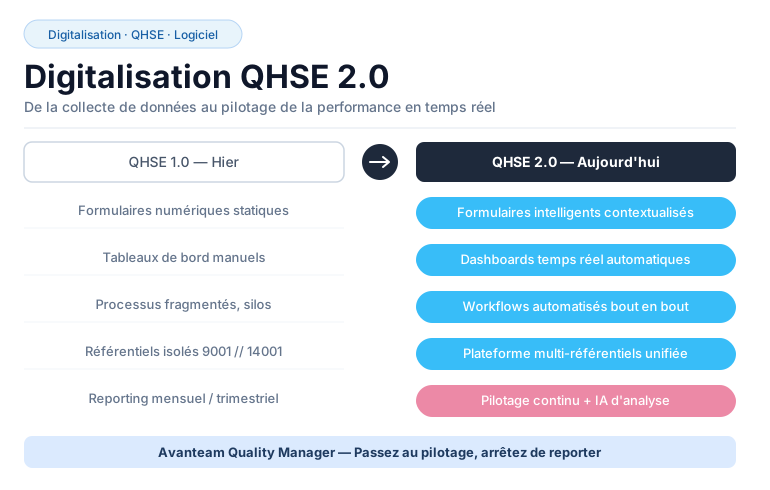
| QHSE Digitalization 1.0 (Yesterday) | QHSE Digitalization 2.0 (Today) |
|---|---|
| Static digital forms | Smart, context-sensitive forms |
| Manually updated dashboards | Real-time dashboards with automatic alerts |
| Fragmented processes, management via email | End-to-end automated workflows |
| Data entry available only at the office | Mobile field data collection, offline |
| Silos by standard (ISO 9001 // ISO 14001) | Integrated multi-repository platform |
| Monthly/Quarterly Reporting | Continuous monitoring with AI-powered analysis |
The 5 QHSE processes to prioritize for automation
Management of Nonconformities and Corrective and Preventive Actions
This is the most time-consuming and critical process. An automated workflow must include: reporting (via mobile), sorting and classification, root cause analysis (using the 5 Whys method), defining actions, validation, tracking deadlines, and closure with proof of effectiveness. Goal: zero emails, zero manual tracking spreadsheets.
Internal audits
Automatic scheduling based on the audit program, preparation of process-specific checklists, data entry via tablet during the audit, automatic report generation, and tracking of nonconformities and associated action plans. Estimated time savings: 40% to 60% across the entire audit cycle.
Supplier Management
Initial qualification, collection of required documents, expiration alerts (certifications, insurance), periodic assessment, supplier development plan. All centralized in a single supplier profile, with compliance status visible in real time.
Quality Document Management
The core of the quality system, which is all too often managed through fragmented file structures and uncontrolled Word versions. An automated document workflow covers the entire lifecycle: collaborative drafting, customizable review and approval workflows, compliant electronic signatures, automatic versioning with a complete history, targeted distribution by position with read receipts, automatically triggered periodic reviews, and regulatory archiving. The result: documentation that is always up to date, enforceable in audits, and accessible with a single click—even from the shop floor or in the field.
Tracking of training and certifications
Job competency matrices, annual training plans, tracking of certifications, alerts for expiring authorizations, and automatically generated certificates. The module that ensures your HR compliance with zero administrative effort.
Avanteam Quality Manager: The QHSE Platform for Digital Transformation 2.0
⚡ Avanteam Quality Manager — Take control, stop putting things off
Real-time QHSE dashboard — Key metrics (non-conformance rate, CAPA closure rate, supplier performance, audit compliance rate) updated continuously, without any manual intervention.
Field mobile app — Smart forms for smartphones and tablets, offline data entry, photo/video integration, automatic synchronization upon reconnection.
Automated QHSE Workflows — Comprehensive management of non-conformities, corrective actions, audits, complaints, and deviations — from reporting to closure, without emails or spreadsheets.
Multi-standard platform — ISO 9001, ISO 14001, ISO 45001, HACCP, GMP, NIS2, CSRD in a single system — enter data once, cover multiple standards.
Trend Analysis AI — Automatically detect patterns in your non-conformities and incidents to identify systemic root causes.
Native integrations — Connect with your ERP systems (SAP, Oracle, Sage), CMMS, and quality control systems to eliminate duplicate data entry.
Use case: a food production facility (350 employees)
This certified production facility previously used four different tools to manage nonconformities, audits, suppliers, and training. Consolidating these processes into Avanteam Quality Manager has yielded the following benefits:
A 65% reduction in the time spent on monthly reporting.
Elimination of 90% of manual follow-ups on CAPAs.
Identification of a systemic root cause (a recurring packaging issue related to a specific supplier) that manual analysis had failed to identify over an 18-month period.
Use case: a pharmaceutical company with multiple sites
This pharmaceutical company, which operates five sites in France, has implemented Avanteam Quality Manager as its unified QHSE platform. The group quality manager can now compare the quality performance of the five sites in real time, identify the site with the lowest performance in internal audits, and initiate a targeted support plan—all from a single dashboard, without having to request reports from anyone.
Conclusion: Quality software in 2026 is a tool for strategic and proactive management
The question is no longer “Do I have quality software?” but “Does my quality software allow me to monitor my performance in real time, prove compliance instantly, and detect problems before they turn into crises?”
Quality managers who have made the leap to Digitalization 2.0 will be the ones who have the greatest impact within their organizations—and who sleep soundly before every audit.
Want to learn more? Let’s talk about your situation.
Request an Avanteam Flash Diagnostic — free of charge and with no obligation.

Author
Marianne Cordier
Quality & Compliance Process Specialist · Avanteam