The current version of ISO 9001 dates from 2015. In the past ten years, the world has changed dramatically: a global pandemic, rapid digital transformation, the climate crisis, the rise of AI, new ways of working, and heightened ethical demands. The standard needed to evolve to remain relevant. On August 27, 2025, ISO published the Draft International Standard (DIS): the official draft submitted for international public consultation.
Why a review in 2026? The circumstances that make it necessary
The ISO 9001 standard is a quality management framework used by more than one million organizations in 170 countries. The last major revision took place in 2015. Since then, operational, technological, and regulatory contexts have changed significantly, making an update essential.
The revision process follows the formal ISO stages: NP → WD → CD → DIS → FDIS → IS. The Draft International Standard (DIS) was published on August 27, 2025. The final version (IS) is expected in October 2026. Organizations certified to ISO 9001:2015 will then have a 3-year transition period, lasting until the end of 2029.
ℹ️ This isn't a complete overhaul
ISO 9001:2026 retains the same structure (Chapters 4 through 10), the same fundamental principles—process approach, customer focus, and continuous improvement—and the same philosophy. It is a targeted update, not a revolution. The transition will be less disruptive than it was in 2015.
The revision schedule
| Due date | Step | What this means |
|---|---|---|
| August 2025 | Publication of the DIS | Draft International Standard submitted for international public consultation. The main points have been established. |
| October 2026 | Publication of the final standard | ISO 9001:2026 officially takes effect. The three-year transition period begins. |
| Late 2029 | End of the transition period | ISO 9001:2015 certifications will no longer be valid. All organizations must transition to the 2026 version. |
The 6 key developments to keep in mind
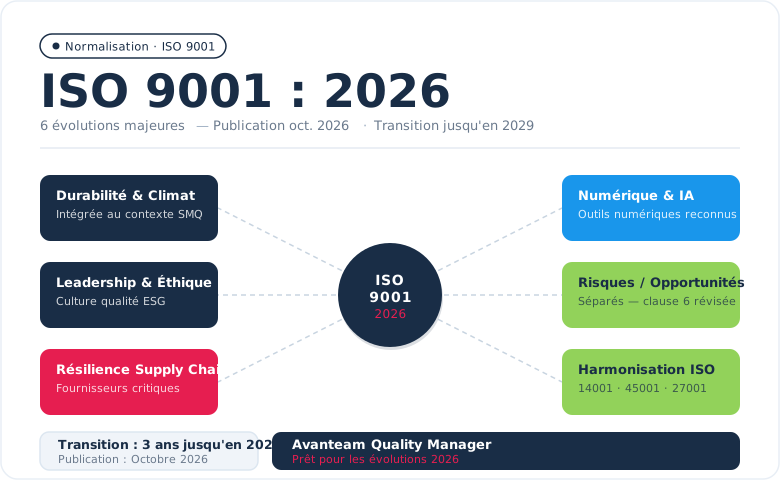
ISO 9001:2026 is not a revolution, but six targeted changes are fundamentally redefining the requirements of the quality management system. Sustainability, digital transformation, ethics, and resilience: these topics are shifting from being optional to becoming mandatory requirements.
| Development | Description | What this means for you |
|---|---|---|
| 🌿 Sustainability integrated into the QMS | Sustainability (environmental, social, and economic) is now explicitly included in the sections on Context, Stakeholders, Objectives, and Improvement. | ✦ Your quality SWOT analysis should take into account climate risks, CSR issues, and the environmental impacts of your processes. |
| 🤖 Digital & AI Recognized | ISO 9001:2026 officially recognizes that digital tools (AI, automation, big data) are an integral part of the QMS, while requiring that the associated risks be analyzed. | ✦ The quality manager must now be involved in projects to select digital tools from the very beginning. |
| 🤝 Leadership, Ethics & Quality Culture | Senior management will no longer be merely the “guardian” of quality; it must become its active advocate. Organizational ethics are now explicitly incorporated into the company’s culture. | ✦ Demonstrate a visible culture of quality: shared values, observable behaviors, integrity, and transparency. |
| ⚖️ Risks & Opportunities Clarified | Chapter 6 has been thoroughly revised. Risks and opportunities are now addressed in separate subsections, with a more granular approach. | ✦ Gone are the days of blurring the lines and lumping everything together in the same risk matrix. Prevention, resilience, and crisis management are now clearly distinguished. |
| 🔗 Supply Chain Resilience | Control over outsourced processes and supply chain resilience are becoming increasingly critical in a post-COVID world. | ✦ More systematic assessment of risks associated with critical suppliers and formalization of business continuity plans. |
| 🔄 Alignment with ISO 14001 / 45001 / 27001 | The new Harmonized System (HS) facilitates the integration of management systems and eliminates redundancies among ISO standards. | ✦ If you already manage an SMI, version 2026 standardizes terminology and simplifies multi-standard management. |
Trends by chapter
Here are the details of the changes, chapter by chapter, and their practical implications for your organization:
| ISO 9001 Section | Key Development 2026 | What this means for you |
|---|---|---|
| 4 — Background | Sustainability and climate change added | Update your context analysis to include CSR and climate issues |
| 5 — Leadership | A culture of quality, ethics, and ESG integration | Formalize quality values and explicitly involve management |
| 6 — Planning | Separate risks and opportunities; enhanced resilience | Review your risk matrix to distinguish between risks and opportunities |
| 7 — Support | Recognized expertise in digital technology and AI; cybersecurity skills | Assess digital tools; train teams on IT risks |
| 8 — Production | Supply Chain: Enhanced Resilience and Assessment | Map your critical suppliers with business continuity plans |
| 9 — Evaluation | Customer satisfaction and loyalty in KPIs | Incorporate the Voice of the Customer as a formalized quality metric |
| 10 — Improvement | CAPA aligned with risk and sustainability | Link your corrective actions to the broader risk map |
Rest assured, this is NOT changing
ISO 9001:2026 fully retains the core principles that have made the standard so successful:
- The structure remains the same with 10 chapters (HLS), and there is no renumbering, so your documentation processes remain valid.
- The process-based approach at the heart of quality management remains unchanged: mapping, managing, and improving processes.
- Customer focus and customer satisfaction remain the central objectives of the QMS, now enhanced with new metrics.
- Continuous improvement through the PDCA cycle remains the driving force behind the system. Corrective and preventive actions (CPA) are being enhanced but are not being phased out.
- The risk-based approach remains in place; it is simply better structured with a clear distinction between risks and opportunities.
- Flexible documentation; no specific procedures are required. Documentary freedom is preserved.
✅ Good news for 2015 graduates
The three-year transition period following publication (i.e., through the end of 2029) gives you plenty of time to prepare for the migration. But the sooner you start planning, the smoother and more cost-effective the transition will be.
A 5-Step Transition Plan for ISO 9001:2015 Certified Organizations
Here is the recommended roadmap for preparing for the transition to ISO 9001:2026, without waiting for the official publication in October 2026:
Conduct a gap analysis
Compare your current QMS with the new 2026 requirements from the DIS. Identify the areas already covered and those that need to be updated. This assessment serves as the foundation for your transition roadmap.
Incorporate sustainability and climate considerations into your context analysis
Include CSR, climate, and societal issues in your quality SWOT analysis. Identify climate-related risks and opportunities in your key processes. This step aligns your QMS with the requirements of the revised Chapter 4.
Review your risk management framework
Separate risks and opportunities into distinct subsections. Add a column on resilience and crisis management for your major risks. This revision of Chapter 6 is the most significant change in terms of operational structure.
Incorporate your digital tools into the QMS
Identify the AI and digital tools used in your quality processes. Assess the associated risks (cybersecurity, algorithmic reliability, dependency) and document their governance within the QMS.
Build a culture of visible quality
Formalize your organization’s quality values. Prepare your leadership to demonstrate its commitment during audits—not just through signatures, but through observable behaviors and ESG indicators.
⚡ Don't wait for the official announcement
The DIS published in August 2025 provides a very accurate preview of the final standard. Organizations that begin their transition now will avoid the pressure of renewal audits in 2027–2028. Every month of early preparation reduces the workload at the time of migration.
How Avanteam Quality Manager Prepares You for ISO 9001:2026
Compliance with ISO 9001:2026 is based on fundamentals that quality teams are already familiar with: context analysis, risk management, living documentation, customer satisfaction, and internal audits. Avanteam Quality Manager is specifically designed to centralize and streamline these processes, with the new 2026 requirements natively integrated.
- Context and stakeholder analysis: a dedicated module that includes the climate and CSR dimensions required by the 2026 version.
- Advanced risk management: a structured registry that distinguishes between risks and opportunities, including resilience levels and business continuity plans.
- Live, traceable documentation: all your quality documents are versioned, approved, and distributed through a comprehensive approval process.
- Integration of digital tools for the qualification and monitoring of software used in quality processes, including management of associated IT risks.
- Augmented executive dashboard featuring real-time metrics that integrate quality KPIs, CSR indicators, customer satisfaction, and supplier performance.
- Internal Audit: Overseeing the planning, execution, and follow-up of internal audits with full traceability and integrated CAPA action plans.
Use case: Certified service organization
Customer feedback formalized in a management review
An ISO 9001:2015-certified service company has incorporated the Voice of the Customer as a formal quality indicator (a requirement emphasized in Chapter 9). Complaints, satisfaction surveys, and field feedback are now centralized and analyzed quarterly in Avanteam Quality Manager.
Gap Analysis and 2026 Transition Roadmap
An ISO 9001- and ISO 14001-certified manufacturer completed its gap analysis in Avanteam Quality Manager in less than a week. The harmonized framework made it possible to share 80% of the new requirements between the two standards, cutting the transition workload in half.
Conclusion: ISO 9001:2026, an opportunity to put quality back at the heart of the strategy
ISO 9001:2026 sends a clear message: quality is no longer an isolated compliance system. It is a strategic driver of resilience, linked to sustainability, digital transformation, ethics, and the organization’s overall performance.
For quality managers, this is a unique opportunity to strengthen their standing with senior management and demonstrate that their role creates value far beyond certification audits. Sustainability, digital transformation, quality culture, ethics, and resilience: these are no longer optional—they are requirements.
Plan ahead now. Organizations that incorporate these changes before the official release will be the ones that experience the smoothest and most rewarding transition.

Coralie Levy
Product Manager · Avanteam