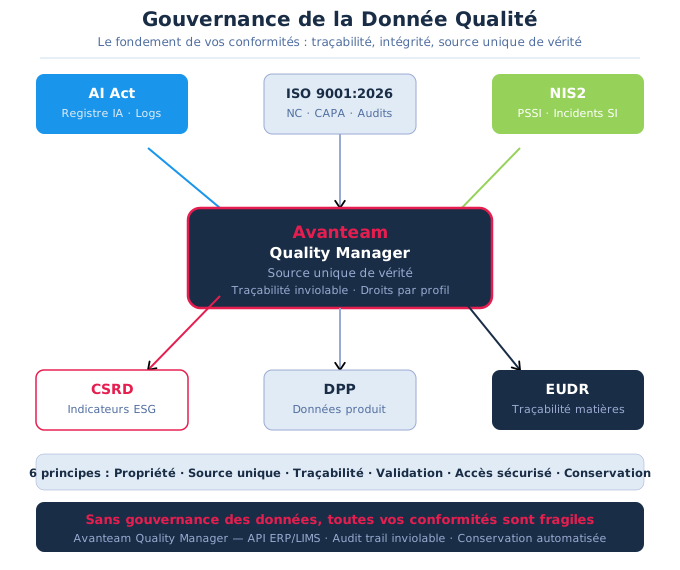
The AI Act, NIS2, CSRD, DPP, and ISO 9001:2026—all these regulations point to the same requirement: track, prove, and audit. But what exactly do you need to prove, and how, if your quality data is scattered across spreadsheets, emails, shared folders, and software systems that don’t communicate with one another?
Why quality data is at the heart of all regulatory requirements
Each regulation from 2026 essentially requires the same thing: reliable, traceable, and auditable data that demonstrates that your processes are under control and your obligations are being met. Here is a summary of the data requirements by regulation:
| Regulations | Required quality data | Evidence required |
|---|---|---|
| AI Act | AI system mapping, technical documentation, monitoring logs | AI log, technical files, incident reports |
| NIS2 | IT Security Policy, Cyber Risk Register, Incident Logs | Versioned PSSI, risk register, ANSSI notifications |
| ISO 9001:2026 | Risk register, process metrics, customer feedback, corrective and preventive actions (CAPA) | Quality records, dashboards, review reports |
| CSRD | ESG indicators, Scope 1/2/3 data, social performance | Data audited by CAC, supporting documentation by indicator |
| DPP | Product composition, certifications, life cycle data | Technical data sheets, supplier declarations, and up-to-date certificates |
| EUDR | GPS coordinates of plots, material traceability chain | Statement of Due Diligence, Supplier Documentation File |
The 5 Signs of Poor Quality Data Governance
You don't know who is responsible for which data
Who updates the supplier profile? Who approves the quality metrics before the management review? Who decides when a record can be archived? If there are no clear answers to these questions, your data governance is inadequate.
There are several versions of the truth
The sales representative has one set of customer complaint figures in a file, the quality manager has another set in a spreadsheet, and management has a third set in its monthly report. Three different versions of the same reality: this is a sign that there is no single source of truth.
Your data is not auditable
During an audit, you cannot prove who modified a record, when, or why. You cannot trace the history of a decision. You have no log of actions taken on your data. This is a critical issue for NIS2, the AI Act, and ISO 9001.
Data collection is done manually and is time-consuming
Before each management review, you spend two to three days collecting data from various departments. This manual data collection leads to errors, delays, and frustration, and it takes up time that should be spent on analysis and taking action.
Your data isn't driving your decisions
Data is collected to meet audit requirements, not to drive performance. The quality department reacts to problems that are reported to it, rather than detecting them early on through its metrics. This is a sign that quality data is not being put to use.
The 6 Principles of Robust Quality Data Governance
- Clear Data Ownership Each type of quality data has a designated owner who is responsible for its quality, updating, and validation. This responsibility is documented in the process sheets.
- Single source of truth: A single application serves as the authoritative source for each type of data. No duplicates, no parallel spreadsheets, no manual exports between systems.
- Full audit trail of changes Every creation, modification, or deletion of a record is time-stamped, signed, and linked to a supporting document. The history is permanent and cannot be modified.
- Integrity and Validation Critical data is validated by an authorized person before being used in decisions or regulatory reports. Validation workflows are formalized.
- Secure Access The right people have access to the right data, with the appropriate permissions, from any device. Access is managed by profile and audited.
- Compliant retention and archiving Regulatory retention periods are adhered to. Archived data remains accessible and auditable. The destruction of data at the end of the retention period is tracked.
Avanteam Quality Manager: The Quality Data Governance Platform
Compliance is based on fundamentals that quality teams are already familiar with: document management, decision traceability, and validation workflows. Avanteam Quality Manager is specifically designed to centralize and streamline these processes.
🗄️ Avanteam Quality Manager — Ensuring Quality Data Governance
- Single source of truth All quality data (non-conformities, corrective and preventive actions, audits, suppliers, documents, metrics) is centralized on a single platform, with no duplication.
- Tamper-proof traceability: Every action (creation, modification, validation, viewing) is time-stamped, signed by an identified user, non-modifiable, and compliant with NIS2 and the AI Act.
- Role-Based Access Control Granular access control by user, organizational unit, and data type, with comprehensive access logs.
- Integrated validation workflows Every piece of critical data follows a formalized approval process before being published or used in regulatory reports.
- Automated retention and archiving: Retention periods configurable by document type, automatic archiving at the end of the retention cycle, and traceability of destruction.
- APIs and Integrations Native integration with ERP, LIMS, CMMS, and other systems to eliminate duplicate data entry and ensure data consistency across systems.
Use case: A pharmaceutical site regains control of its NCs and CAPAs
This GMP-certified pharmaceutical facility used to handle non-conformities the old-fashioned way: reports scattered across paper forms, emails, and Excel spreadsheets; CAPA actions closed without a proper root cause analysis; and nearly 30% of the issues resurfacing in some form within the year.
With Avanteam Quality Manager, the process has been completely redesigned: mobile reporting from the production floor, automatic classification by criticality, 5 Whys/Ishikawa analysis integrated into the workflow, electronic pharmaceutical validation compliant with 21 CFR Part 11, and, most importantly, formalized effectiveness verification prior to closure. Results after 12 months: average processing time reduced by two-thirds, recurrence of non-conformities brought below 8%, and zero observations during the latest GMP audit regarding deviation control.
Conclusion: Without data governance, all your compliance efforts are at risk
You may have the best quality processes in the world, the most robust policies, and the most comprehensive training programs—but if you can’t back them up with reliable, traceable, and auditable data, your compliance is merely theoretical.
By 2026, quality data governance will no longer be an IT issue reserved for the IT department. It will be a strategic quality issue, and it is up to you to lead the way.
Don’t just comply with regulations—take control of them. With the right tools and approach, your data governance can be up and running right away.

Richard Garcia
Director of Operations